
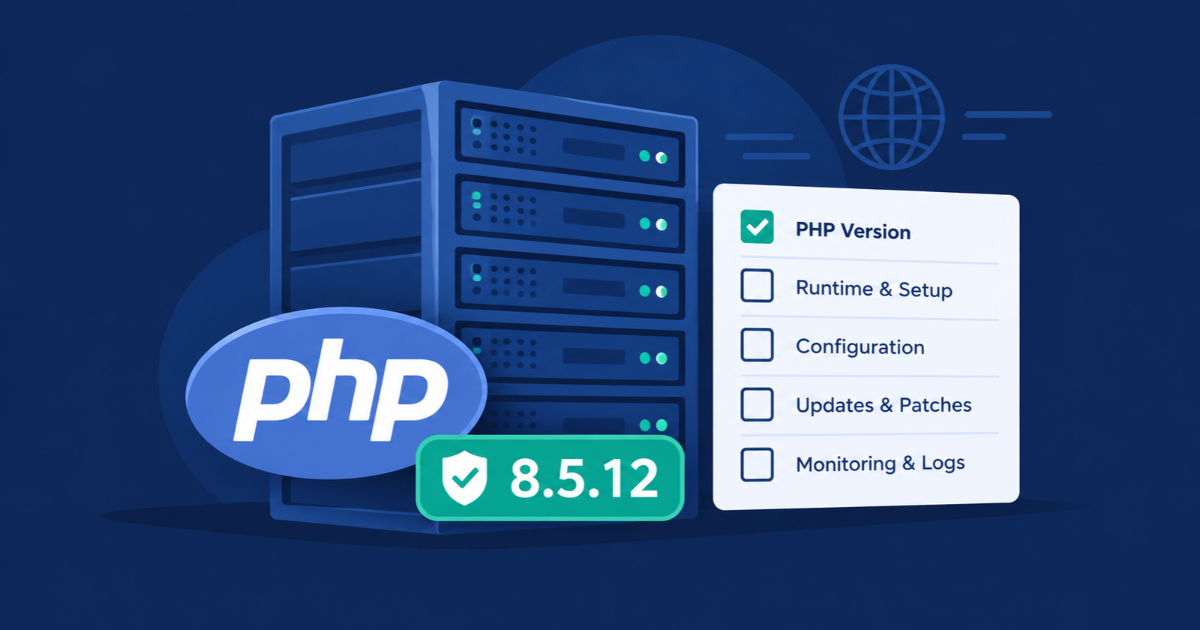
On 21 October 2026, the PHP project released PHP 8.5.12, 8.4.27, 8.3.36 and 8.2.35 to fix two critical vulnerabilities. According to the official advisory, both can allow unauthenticated remote code execution, and the project urged all PHP users to update immediately.
For many companies this is a question they cannot answer on the spot: which PHP version does our website actually run, and has it been patched? A site can load quickly, take orders and look perfectly healthy while the software underneath is out of date. This article explains what was announced, which systems should be checked first, and what a sensible response looks like. The central point is simple: keeping a website operational is not the same as keeping it secure and properly maintained.
What happened
The two flaws are tracked as CVE-2026-109618 and CVE-2026-109619, and both are rated critical with a CVSS v4.0 score of 9.2.
- CVE-2026-109618: if PHP runs out of memory at the wrong moment while handling a request, cleanup can treat half-built internal data as valid. The advisory classes this as remote code execution through out-of-memory corruption.
- CVE-2026-109619: internal data from one request can remain after its memory has been freed, and a later request handled by the same worker may use it before it is reset.
Both issues affect the same versions:
PHP branch | Affected versions | Patched version |
|---|---|---|
8.5 | before 8.5.12 | 8.5.12 |
8.4 | before 8.4.27 | 8.4.27 |
8.3 | before 8.3.36 | 8.3.36 |
8.2 | before 8.2.35 | 8.2.35 |
The advisories describe validated attack paths on Apache with mod_php and on PHP-FPM, and the PHP project considers the risk highest for mod_php. Both advisories also rate attack complexity as high, which means exploitation depends on specific conditions. Exposure is not the same for every installation.
What has been reported about exploitation. The PHP advisory itself does not report attacks in the wild, but it does describe a demonstrated exploit for mod_php. Separately, Amazon's security team reported seeing exploitation attempts against its honeypot network, the earliest on 17 October, four days before public disclosure, followed by more attempts and several proof-of-concept exploits after the release. Amazon says the payloads varied, which suggests multiple actors, and that it is unclear whether any of these attempts would have succeeded against real-world systems. In other words, attempts have been observed; the source does not report confirmed compromises of production systems. The PHP Foundation also notes that the CVE identifiers appeared online before the planned release and that a proof-of-concept demonstration was published by mistake on release day.
What remote code execution means
Remote code execution (RCE) means that someone outside your organization could make a server run commands of their choosing. Here, the advisory describes the attacker as unauthenticated, so no login is needed.
In principle, code running on a web server can reach whatever that server can reach: application files, configuration containing database credentials, customer data and connected internal systems. Whether that happens in practice depends on how the server is set up, which PHP runtime it uses and whether the patch is in place. A vulnerability being critical does not mean a given company has been breached. It means the cost of leaving it unpatched is high enough to justify acting quickly.
Which systems should be checked
Start with these questions:
- PHP version. Systems on PHP 8.2 to 8.5 below the patched releases are in scope. PHP 8.1 and older no longer receive updates from the PHP project, although the PHP security team published minimal source backports for 7.4, 8.0 and 8.1, and some Linux distributions and long-term-support vendors provide their own backported fixes. A vendor-patched package can carry an older version number, so check the vendor's advisory rather than relying on the number alone.
- How PHP runs. The advisory lists PHP-FPM, Apache mod_php, php-cgi, FrankenPHP and LiteSpeed as affected setups, with mod_php at highest risk.
- Configuration. The advisory notes that session upload progress is enabled by default, and that one confirmed path on PHP 8.5 involves the fatal_error_backtraces setting. Your IT team or host can tell you how these are set.
- Who manages the server. On shared hosting, managed platforms or containers, the provider or image maintainer may control PHP. Ask them for their position and timeline.
- Who maintains the application. If an outside vendor runs your website or internal system, ask them in writing which PHP version it uses and when it will be updated.
What businesses should do
A practical order of work:
- Identify what you run. List your PHP-based websites, applications and internal tools, the PHP version each uses and who is responsible for it.
- Check vendor and hosting guidance. Look for advisories from your hosting provider, Linux distribution or application vendor, and note whether they ship backported fixes.
- Update to a patched release. The advisory says only an update is a complete solution. Use 8.5.12, 8.4.27, 8.3.36, 8.2.35, or your vendor's patched package.
- Test, then roll out. Where possible, apply the update in a staging environment first, check key functions such as logins, forms and uploads, and then deploy. Prioritize internet-facing systems.
- If you cannot update today, apply the temporary measures. The advisory lists settings such as disabling session upload progress and limiting request sizes, and Amazon suggests blocking multipart file uploads after testing the impact. Both sources are clear that these reduce exposure but do not make a system safe.
- Review for suspicious activity where appropriate. Amazon recommends checking web server logs for POST requests containing PHP_SESSION_UPLOAD_PROGRESS, looking for unexpected process execution or file changes on application servers, and starting the review from 17 October rather than the disclosure date. A review that finds nothing is not proof that a system was untouched.
- Plan beyond this patch. If you run PHP 8.1 or older, agree an upgrade path with your vendor. PHP 8.2 reaches end of life on 31 December 2026.
The broader lesson
This incident is not an argument against PHP. The PHP project and PHP Foundation published fixes, advisories and mitigation guidance quickly, and the PHP Foundation has described changes to how it handles security reports. What the news shows is that software needs an owner after launch.
A website that works for visitors can still be running unsupported software, outdated libraries or a configuration nobody has looked at in years. Keeping a system properly maintained means:
- Regular updates for the PHP runtime, frameworks, plugins and other dependencies.
- Configuration reviews, so that defaults and old settings are checked deliberately.
- Monitoring and logging that someone actually reads.
- Upgrade planning, so that end-of-life dates such as 31 December 2026 for PHP 8.2 arrive as scheduled projects rather than emergencies.
- Clear responsibility for who patches what, and how quickly.
Speed matters too. Amazon argues that the time between a patch and working exploit code is shrinking, partly because of AI-assisted analysis, and recommends measuring response to critical internet-facing flaws in hours rather than days or weeks. That is Amazon's assessment, but it supports having a process that can move fast.
How SUM Digital can help
SUM Digital is a software development partner. If your company runs a PHP-based website or web application, we can help you establish which PHP version and setup it uses, review how the system is currently maintained, and plan updates or upgrades together with your team, hosting provider or application vendor.
This is a technical review of an existing system and a conversation about next steps. It is not a security audit, penetration test or incident response service, and it cannot guarantee that a system is free of vulnerabilities. If you suspect that a system has already been compromised, contact your hosting provider or a qualified security specialist.
Conclusion
The 21 October PHP releases are a reminder that an operational website still needs ongoing maintenance. Know which PHP version your systems run, confirm they are patched, and make sure someone is responsible for keeping them that way.
Not sure where your PHP-based website or system stands? Contact SUM Digital to talk through a technical review of your existing system.
Sources
- PHP news archive, security advisory of 21 October 2026: fixed versions, risk by runtime, temporary measures, guidance for PHP 8.1 and older, 8.2 end-of-life date.
- GHSA-w8hw-w9fx-j79w (CVE-2026-109618): description, CVSS v4.0 9.2, affected and patched versions.
- GHSA-6wmf-4rv5-p3rp (CVE-2026-109619): description, CVSS v4.0 9.2, affected and patched versions, default session upload progress.
- PHP Foundation: Today's PHP Security Release, and How We're Strengthening PHP Security: disclosure timeline, release-day proof-of-concept, security process changes.
- AWS Security Blog: Amazon Threat Intelligence identifies PHP2Shell exploitation prior to public disclosure in MadPot: observed exploitation attempts from 17 October, log-review recommendations, patch-speed guidance.