
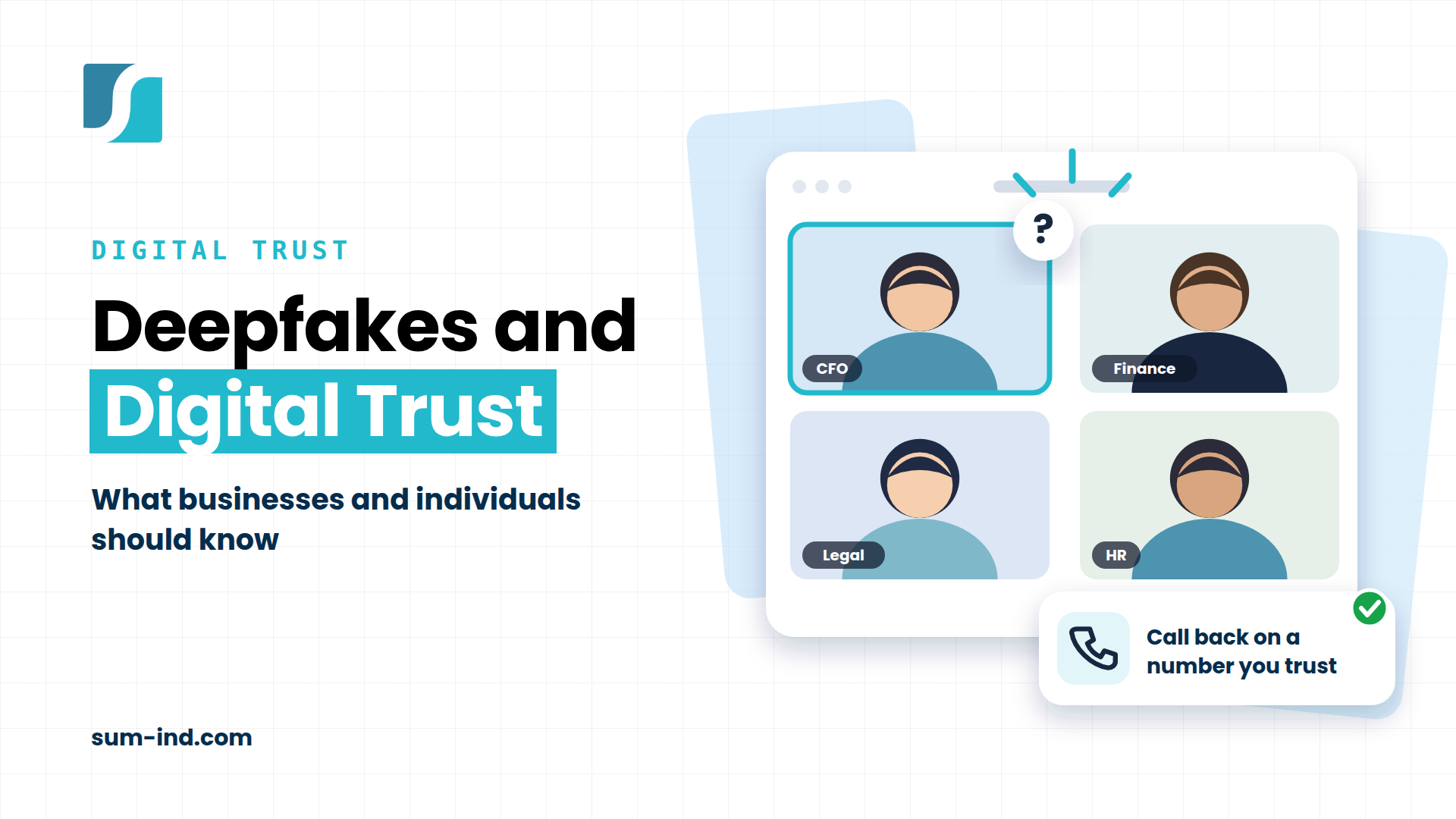
In early 2024, a finance employee at Arup's Hong Kong office joined a video call with the company's CFO and several colleagues. They looked right and sounded right. According to Hong Kong police, none of them were real. By the end, the employee had sent HK$200 million, roughly US$25.6 million, in 15 transfers to five local bank accounts. Arup later confirmed it was the company involved and that fake voices and images had been used.
He had doubted the email that started it, a request for a confidential transaction. The video call is what changed his mind.
That detail is worth sitting with. The call didn't sneak past his judgment; it was the thing he used to check.
Seeing is no longer proof
For most of the internet's history, a video clip or a voice message counted as evidence. Cheap, convincing synthetic media has worn that habit down. Images, voices, and videos can now be generated or altered to look authentic, and a misleading clip can reach many people before anyone checks it.
Don't build your defence on spotting glitches. Whatever flaw gives a fake away today may be gone in the next version of the tool, so checking the source and the context works better than staring at a face.
Six questions before you trust or share
These work for anyone, on any platform, with no special software.
- Who posted it first? Find the earliest upload. Reposts and screenshots only show who passed it along.
- What is it actually claiming? Compare what you can see with the caption placed on top of it.
- When was it made? Old footage can come back wearing a new caption.
- Where was it filmed? Signs, landmarks, and spoken language can confirm a location or contradict it.
- Why was it posted? To inform, to persuade, to sell, or to provoke a quick reaction. A strong emotional pull is a good reason to pause.
- How can you confirm it? Look for credible reporting or official information that reached the same conclusion on its own. Ten reposts of one clip are still one source.
What businesses should change
An individual can slow down. A company needs rules that slow everyone down at once, because an attacker only needs to find the one person who is in a hurry.
- Confirm money and access requests on a second channel you already trust. If a payment request arrives by email and gets "confirmed" on a video call, call the person back on a number from your own directory.
- Require two approvers for transfers above a limit your finance team sets. No single employee should be able to move a large sum because someone senior asked on a call.
- Write down that a face or voice on a call is not proof of identity, and say it during onboarding. People follow a rule they've seen on paper more readily than an instinct they have to defend in front of what looks like their CFO.
- Treat urgency and secrecy as warning signs. In the Arup case the request was for a confidential transaction, which is exactly the kind that deserves a second look.
It also helps to run a short drill once or twice a year: a fake request, a real approval process, and a debrief afterward. Teams that have practised saying "let me verify that first" find it much easier to say when it counts.
Digital trust is a habit, not a product
No tool will make these decisions for you. Verification costs a few minutes; skipping it, in the Arup case, meant HK$200 million.
The same habit applies to what we pass on. Every time someone shares a clip they haven't checked, they lend it their own credibility. That's worth protecting, for individuals and for companies alike.
Pause. Verify. Then share.
If your team is rethinking how it verifies requests, approvals, and content, SUM Digital Consulting can help you set it up. Get in touch at sum-ind.com.
Sources
- South China Morning Post, "UK multinational Arup confirmed as victim of HK$200 million deepfake scam": https://scmp.com/news/hong-kong/law-and-crime/article/3263151/uk-multinational-arup-confirmed-victim-hk200-million-deepfake-scam-used-digital-version-cfo-dupe
- Building, "Arup named as victim of £20m deepfake scam": https://www.building.co.uk/news/arup-named-as-victim-of-20m-deepfake-scam/5129479.article
- Construction Briefing, "Arup employee falls victim to US$25 million deepfake video call scam": https://www.constructionbriefing.com/news/arup-employee-falls-victim-to-us-25-million-deepfake-video-call-scam/8037338.article