
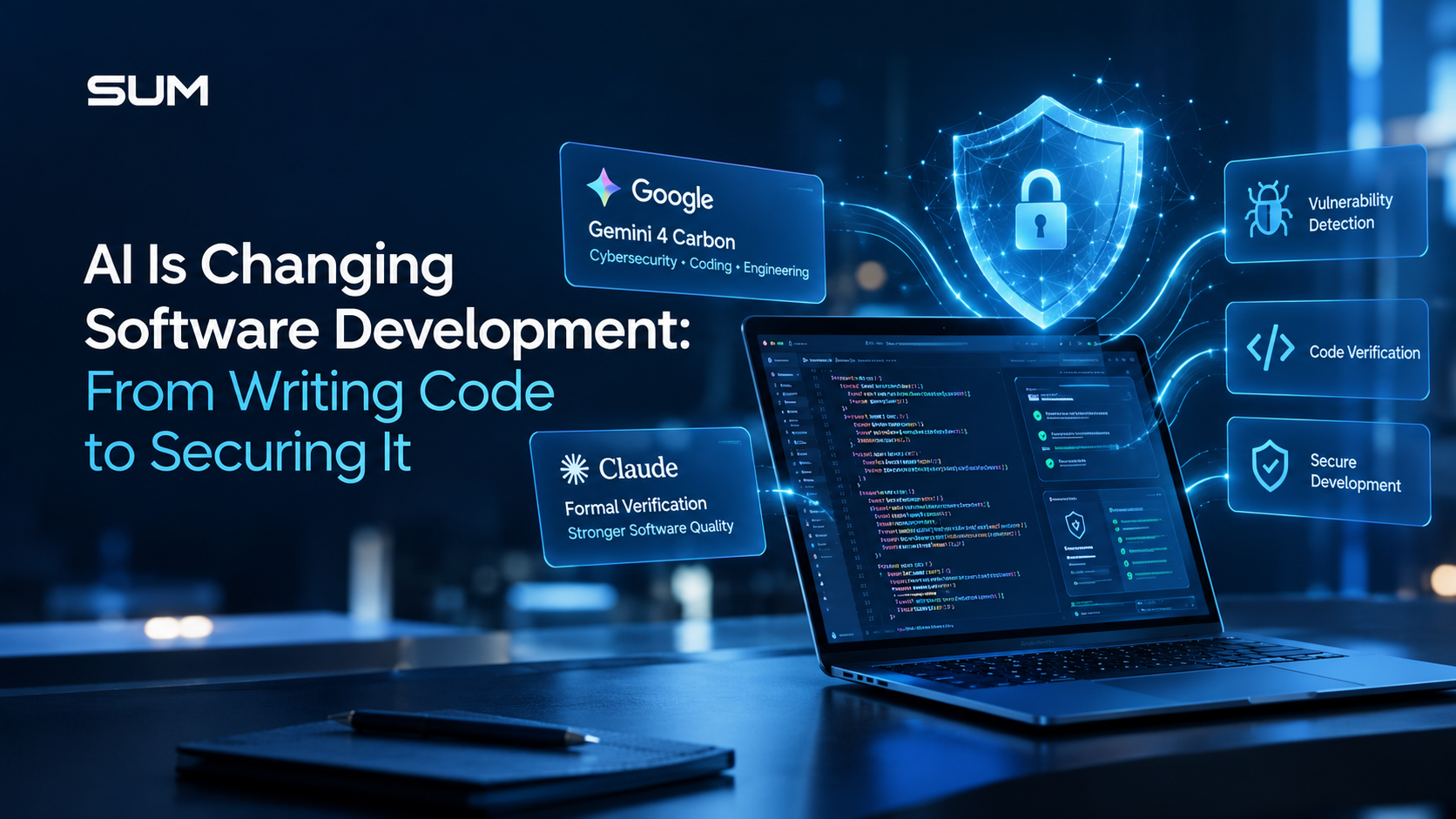
Artificial intelligence is changing software development at a pace that goes beyond generating code. Recent developments from Google and Anthropic demonstrate how AI is becoming increasingly capable of identifying software vulnerabilities, verifying code behavior, and supporting more advanced engineering workflows.
For businesses that rely on digital infrastructure, this shift presents both new opportunities and important security considerations.
Here are three developments shaping the future of AI-powered software engineering.
1. Google Introduces Gemini 4 Carbon for Advanced Cybersecurity
On October 28, 2026, Google introduced Gemini 4 Carbon, a new frontier AI model designed to handle complex engineering tasks and advanced cybersecurity challenges.
Unlike conventional AI coding assistants that primarily help developers generate or explain code, Gemini 4 Carbon focuses on multiple stages of the cybersecurity process, including vulnerability discovery, exploitation assessment, and software patching.
According to Google's published benchmarks, the model achieved:
- 88.2% on SEC-bench Pro for identifying software vulnerabilities.
- 54.8% on ExploitGym for assessing exploitation capabilities.
- 71.0% on CWE-bench for developing vulnerability patches.
These results highlight how AI models are evolving beyond development assistance into more specialized security applications.
Google is initially providing access to selected cybersecurity professionals through its Fairwind Program while continuing to evaluate safety measures.
2. Anthropic Demonstrates AI-Powered Formal Software Verification
Another significant development comes from Anthropic, which published research demonstrating how its Claude models can support formal software verification at a much larger scale.
Working with Theorem, Anthropic used Claude to produce mathematical proofs of specific software security properties across 123 open-source libraries. The research covered 239 entry points and identified bugs that had remained undetected despite extensive previous testing.
Formal verification is particularly important because conventional software testing cannot guarantee that every possible execution path has been examined. By generating machine-checkable proofs, AI can help developers establish stronger guarantees about how software behaves under defined conditions.
However, formal verification does not automatically mean that an entire application is bug-free. The guarantees depend on the specifications, assumptions, and components included in the verification process.
This development suggests that AI could become an important part of future software quality assurance and secure development practices.
3. AI Is Accelerating Vulnerability Discovery, Raising New Security Concerns
The growing capabilities of AI also introduce new cybersecurity challenges.
A Reuters report published on October 23 highlighted concerns from cybersecurity experts that AI is accelerating the discovery of software vulnerabilities. Research from threat intelligence firm VulnCheck indicated that discovered digital flaws had doubled year over year, partly due to AI-assisted discovery.
The implications are significant.
AI can help security researchers identify weaknesses more efficiently, but similar capabilities could also be used by malicious actors to identify exploitable vulnerabilities and develop attacks. This creates a narrower window for organizations to respond to emerging security threats.
Businesses can no longer rely solely on traditional security checks performed at the final stages of development. Continuous vulnerability monitoring, timely patching, access controls, and secure development practices are becoming increasingly important.
What These Developments Mean for Businesses
These developments point toward a broader transformation in software engineering. AI is gradually moving from being a productivity tool to becoming an active participant in the software development lifecycle.
For businesses, three considerations stand out:
1. Security needs to be integrated into development from the beginning.
Identifying vulnerabilities early is generally more efficient than addressing security incidents after deployment. AI-assisted analysis can strengthen existing security workflows, but it should complement rather than replace established security practices.
2. Software quality requires more than faster development.
Generating code quickly does not necessarily produce reliable software. Testing, code reviews, validation, and security verification remain essential to ensuring that applications meet their intended requirements.
3. Human oversight remains critical.
AI-generated recommendations and automated actions must be evaluated within the context of business requirements, security policies, and operational risks. Human expertise is still necessary to define requirements, validate outcomes, and make important decisions.
Looking Ahead: Building More Secure Software with AI
The latest AI developments demonstrate that the future of software engineering will not be defined by how quickly developers can write code alone. It will increasingly depend on how effectively organizations combine AI capabilities with engineering expertise, security standards, and reliable development processes.
For businesses investing in digital transformation, adopting AI should involve more than introducing new tools. It requires a clear understanding of how these technologies can improve productivity, strengthen software quality, and reduce operational risks.
At SUM Digital, we believe that meaningful digital innovation should be built on a balance of technology, reliability, and security.
The future of software development is not simply about building faster. It is about building smarter, more reliable, and more secure digital solutions.
References & Further Reading
The following sources were used as references for this article:
- Google DeepMind (October 28, 2026)
Gemini 4 Carbon: Our Next Frontier Model
https://blog.google/innovation-and-ai/models-and-research/gemini-models/introducing-gemini-4-carbon/ - Anthropic (October 2026)
LLMs Are Making Formal Software Verification Feasible at a Much Larger Scale
https://www.anthropic.com/research/formal-verification - Reuters (October 23, 2026)
AI-Discovered Bugs May Soon Trigger Fresh Disruptions, Cyber Experts Say
https://www.reuters.com/legal/litigation/ai-discovered-bugs-may-soon-trigger-fresh-disruptions-cyber-experts-say-2026-10-23/ - Reuters (October 28, 2026)
Google Launches Gemini 4 Carbon AI Model with Cybersecurity Focus
https://www.reuters.com/technology/google-launches-gemini-4-carbon-ai-model-with-cybersecurity-focus-2026-10-28/